
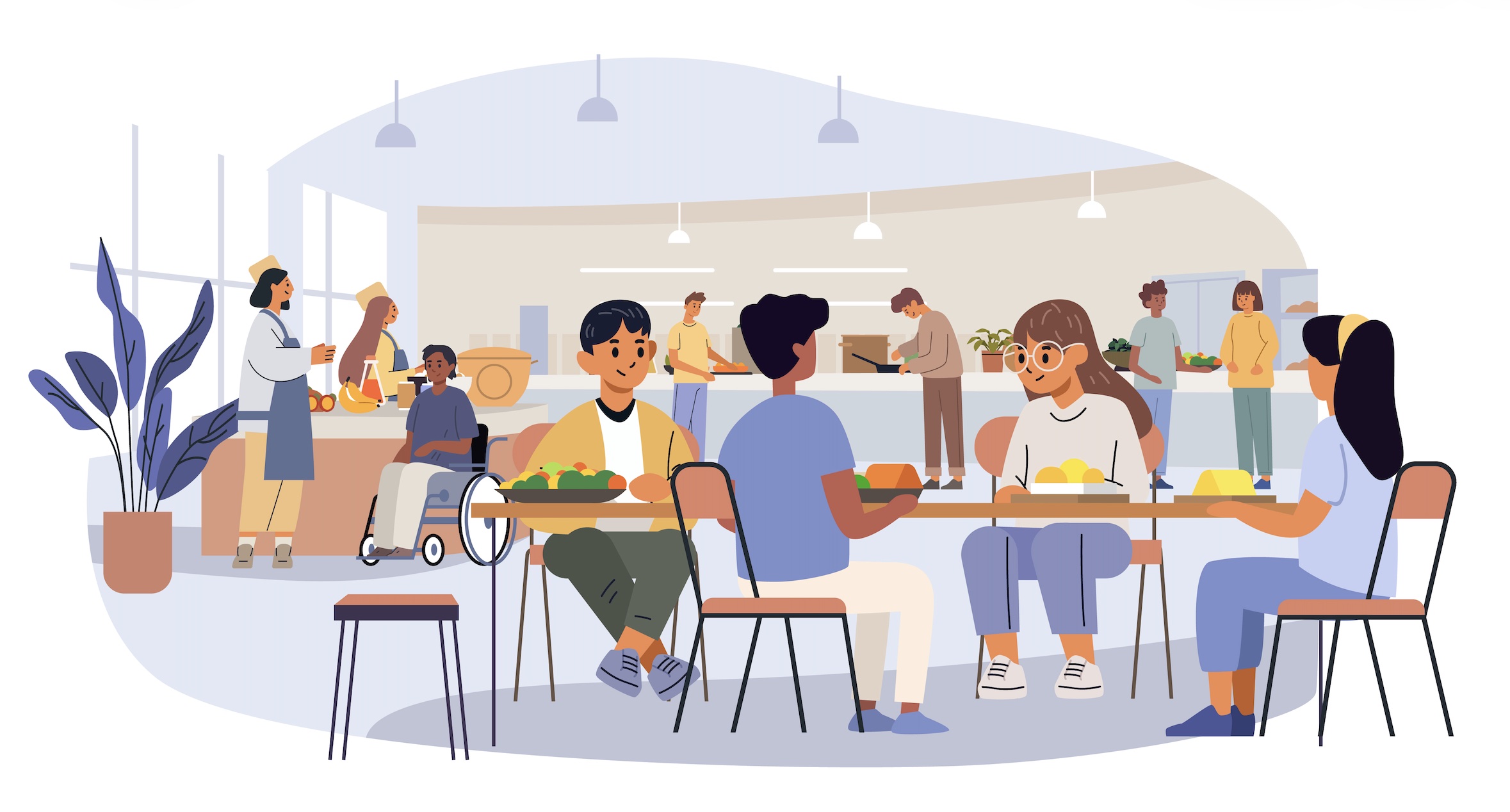
Food Is the Excuse. Connection Is the Outcome.
For more than 35 years, I have walked campuses across North America asking presidents, trustees, and boards a deceptively simple question:
Where does community actually happen?
Not where it is programmed.
Not where it is marketed.
Not where we hope it happens.
Where does it actually happen?
The answer is hiding in plain sight.
It happens two or three times a day.
Campus dining may be the most under-leveraged strategic asset in higher education. It is the single most consistent daily catalyst for building community, sparking engagement, and creating the friendship networks that ultimately determine whether students persist or depart.
Food is the excuse.
Connection is the outcome.
The Student Clock
If we are serious about belonging, we must understand what I call the Student Clock.
The Student Clock is not the administrative clock.
It is not the faculty clock.
It is not built around 8:00 a.m. to 5:00 p.m.
It reflects the natural rhythm of students’ lives.
If institutions fail to design around that rhythm, they miss the moment.
Recently, during a conversation with a group of high school students preparing for college, we asked a simple question:
“Where is the one place in school where you most look forward to seeing and connecting with your friends?”
They did not hesitate.
“The cafeteria.”
Not the classroom.
Not the gym.
Not the football field.
The cafeteria.
They described it as the social reset of their day, the place where friendships deepen, and laughter lives.
Then we asked another question.
“How late do you stay connected with your friends online?”
The answers came quickly.
“1:00 a.m.”
“2:00 a.m.”
“Sometimes 3:00 a.m.”
Think about that.
Teenagers are already operating on a social clock that runs well past midnight, even if it is happening digitally.
When they arrive at college, that digital connection becomes physical freedom.
They will not just message.
They will gather.
The question for institutional leaders is simple:
Where will that energy go?
Freedom Without Design Is Risk. Freedom With Design Is Strategy.
When students gain independence, they seek proximity to friends.
If dining is closed…
If meal plans are restrictive…
If late-night options are minimal…
If the environment feels transactional…
Students will simply go elsewhere.
But if dining is open…
If meal plans are flexible…
If menus are relevant and inclusive…
If the space invites students to linger…
Students will gather in the safest and most socially vibrant space on campus.
Late-night dining is not just an amenity.
It is a safety strategy.
It is a belonging strategy.
It is a retention strategy.
Meeting students where they are, on their clock, sends a powerful message:
We see you.
We understand you.
We are designing for you.
That message builds trust.
Trust builds belonging.
The Retention Equation
Let’s connect the dots clearly.
Connection → Belonging
Belonging → Retention and persistence
Retention → Enrollment strength
This is not soft language.
It is enrollment math.
Students rarely leave institutions where they have formed strong friendship networks.
Where are those networks most predictably formed?
Around tables.
Two or three times a day.
Dining is the only campus experience that intersects with nearly every residential student repeatedly.
Repetition builds familiarity.
Familiarity builds comfort.
Comfort builds belonging.
Belonging drives persistence.
SOCIAL ARCHITECTURE™ in Motion
Belonging does not happen accidentally.
It is designed.
That is SOCIAL ARCHITECTURE™, the intentional shaping of space, operations, and hospitality culture to foster human connection.
A dining hall designed purely for throughput produces transactions.
A dining program designed around the Student Clock produces community.
Round tables reduce isolation.
Communal seating sparks new relationships.
Micro-environments support different personalities.
Lighting shifts tone as the day evolves.
Staff engagement humanizes the experience.
When students linger, relationships deepen.
When they grab and go, opportunity evaporates.
Walk your dining hall at 9:30 p.m.
Is it alive?
Or is it dark?
The answer may be forecasting your retention rate.
Abundance Thinking
Too often, dining is evaluated through a lens of scarcity:
How do we cut costs?
How do we minimize labor?
How do we protect margin?
These are necessary questions.
But they are incomplete.
Abundance thinking reframes the conversation:
How do we leverage dining as the daily engine of engagement?
How do we design meal plans that encourage gathering?
How do we align hours of operation with student behavior, rather than administrative convenience?
Consider this.
You could lower your utility bill at home by shutting off hot water for an hour every morning, several hours each afternoon, and again every evening.
Technically, you would save money.
But no rational household would design life that way.
Why?
Because hot water is not a luxury.
It is basic infrastructure for daily living.
Now think about dining.
If connection drives belonging, and belonging drives retention, then dining access is not a luxury.
It is infrastructure.
Turn it off at the wrong times, and engagement drops with it.
Margins follow meaning.
When students feel connected, they stay.
When they stay, enrollment stabilizes.
When enrollment stabilizes, financial strength follows.