
David Porter is the pioneer of creating community with Next-Gen Residential and Retail Dining crafted through the lens of SOCIAL ARCHITECTURE™ and Abundance Thinking for campus dining programs.
For thirty-six years, I have told campus leaders that food is the excuse and connection is the product. I meant it as a statement about community and retention. This month a laboratory in Jerusalem gave it a footnote I did not expect.
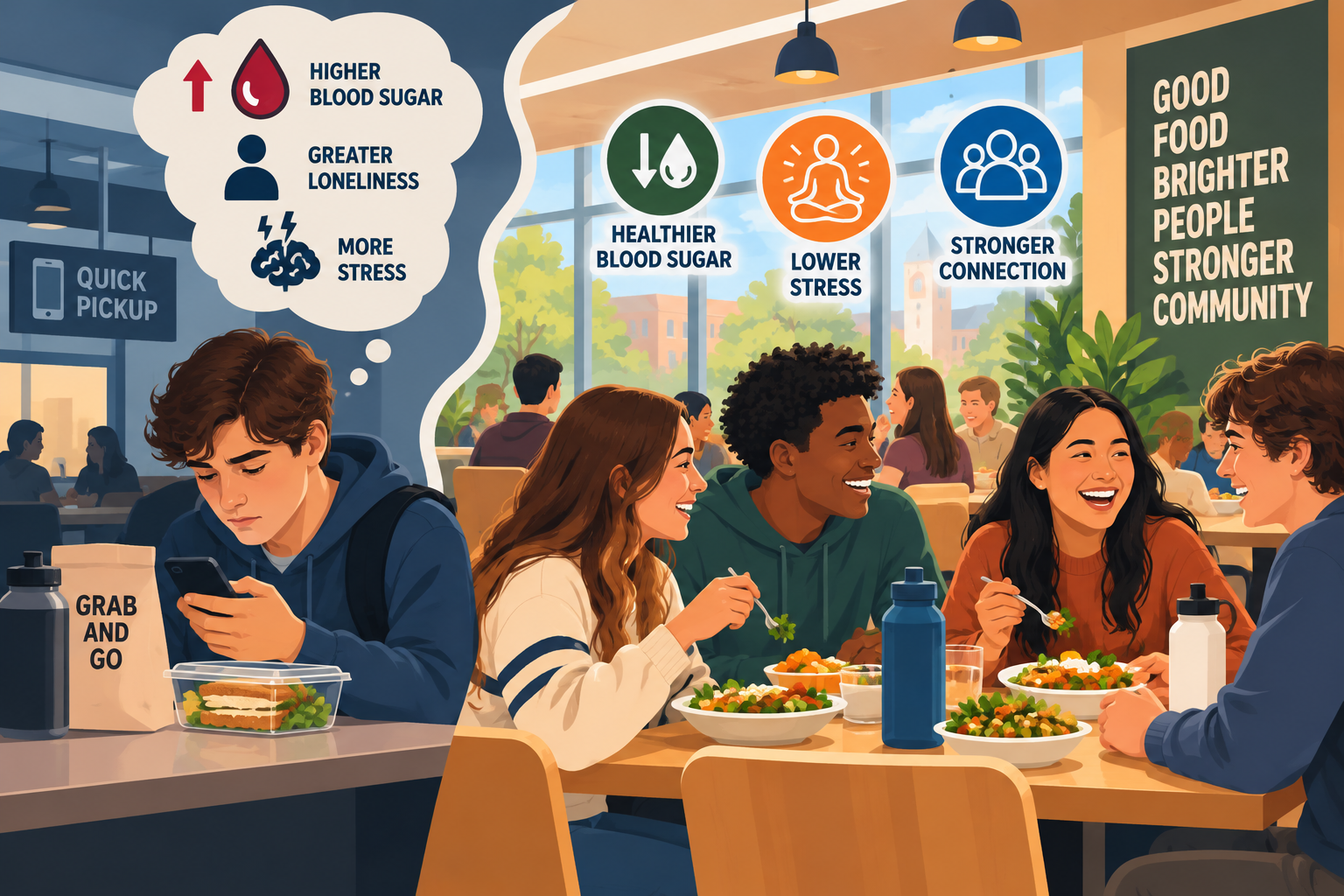
Researchers at the Hebrew University of Jerusalem, publishing in Science Advances, asked 108 adults to eat the same thing: a little over 100 grams of plain white bread. Half ate it alone. Half ate it with a close companion. Then the scientists tracked blood sugar for two hours. Same bread, same portion, same two hours. The people who ate with someone saw their blood sugar rise less and return to baseline faster.
The same paper ran two more experiments. In one, 116 people were exposed to cold, and their bodies regulated temperature more efficiently when a partner was present, even without touching. In another, 115 adults and 56 mother-infant pairs faced a stress challenge, and the physical signs of stress were smaller and recovered faster when another person was in the room. The lead researcher, Shir Atzil, put the conclusion in one sentence: “Blood sugar regulation is not just about what we eat, but who we eat with.” And then a larger one: “Our findings show that human physiology is inherently social.”
I am not a physiologist. This is one experiment with 108 adults, not a study of college students, and the long-term health effects are an open question the researchers themselves flag. I am pointing at the direction, not the decimal. But the direction deserves a hard look from anyone who designs how 18-year-olds eat.
The Other Study
Earlier this year, researchers surveyed 255 students at a British university about where, when, and with whom they eat. Three findings line up with the Jerusalem lab in a way that should make every dining director pause.
First, eating alone at dinner carried the strongest association with loneliness of any meal of the day. Breakfast alone did not register. Dinner alone did.
Second, first-year students were lonelier than any other group on campus, by a meaningful margin.
Third, the students who always used a device or a screen while eating were the loneliest of all. And the reasons students gave for eating alone mattered: those who did it because of apprehension about reaching out, or discomfort eating with others, or simply having no one to ask, were lonelier than those who chose solitude.
It is one campus and a modest sample. But read the two studies together. The body does better with company at the table. The loneliest students on a campus are the newest ones, eating dinner alone, looking at a phone.
Now Look at What We Are Building
Walk the expo floor at any campus dining conference this fall and count the products designed to let a student eat without sitting down with anyone. Mobile ordering. Pickup lockers. Grab-and-go coolers. Robot delivery to the residence hall door. Cashierless markets where nobody says your name. Every one of them is sold as convenience, and every one of them is, by design, a meal eaten alone, almost always with a screen.
I am not anti-technology. A student who gets out of lab at 2:10 deserves a fast way to eat, and I have never argued otherwise. My argument is about what the campus treats as the default and what it treats as the exception. On too many campuses, the dining commons has become the exception: limited hours, gaps between meal periods, little or nothing late at night, less on weekends, stations running out before the posted close. What I call the cafeteria operating system teaches a freshman in her first weeks that the room cannot be counted on, and the locker in the lobby teaches her that she does not need it. Both lessons point her toward the dinner the research says is hardest on her.
Freedom and Social
Over the past thirty-six years of interviewing newly minted freshmen, I have asked what they were looking forward to about college back when they were high school seniors. The answer comes back in two words, almost universally: freedom and social.
Nobody has ever said “a locker.”
The dining commons, run as a Social Coliseum, is the one place on campus where the social half of that answer happens without anyone having to arrange it. It is to a campus what the kitchen is to your home. Friendship is produced by repetition without obligation: the same faces, at the same tables, at the same hours, until the accidental third dinner with the same crew quietly becomes a friend group. Nothing is asked of a freshman except that she be hungry. The British students who were apprehensive about reaching out did not need a program. They needed a room where joining a table is easy, staying is natural, and sitting alone is a choice rather than a sentence.
That is what table configurations that invite joining are for. It is what alone connectedness means: a student eating by herself, still inside the hum of the crowd, is not eating alone in the sense that worried the researchers. She is in the room. The body, apparently, can tell the difference.
Our mini documentary, SOCIAL ARCHITECTURE™: The Missing Ingredient, directed by Emmy Award-winning filmmaker Nick Nanton, was filmed on four campuses across two countries. The voices are first-year students describing what it feels like when a campus engineers belonging instead of leaving it to chance. Watch the mini documentary. Listen for how often they describe dinner.
The Question for Your Campus
Voluntary participation is the purest measure of value. If your residential commons holds roughly 70 percent meal plan participation, without equivalencies, swipes, or exchanges in retail propping up the count, your students are choosing the table, and the research suggests their bodies and their friendships are better for it. If participation is falling while locker volume rises, your program is winning the convenience contest and losing the one that matters.
So here is the test. Pull two numbers for a Tuesday in October: how many meals were eaten in the commons, and how many were picked up, delivered, or carried out. Then ask the cabinet which direction those two lines are moving, and whether anyone decided they should.
Who a student eats with changes her blood sugar. It almost certainly changes whether she comes back as a sophomore. Both are not only solvable, but preventable. Build the room through the lens of SOCIAL ARCHITECTURE™ and Abundance Thinking, keep it open when students are hungry, and the most important thing on her plate will be the person across from it.
Sources:
- Masalha, M., Cohen, M., Aloni, M., Toledo, E., Stahl, E., Shachar, D., Eliav, O., Fuchs, S., & Atzil, S. (2026). “Social Physiology: Human Homeostasis Is More Efficient in Social Proximity.” Science Advances, 12(39). Hebrew University of Jerusalem and Sheba Medical Center. https://doi.org/10.1126/sciadv.aeg4937
- Cassella, C. (2026, October 1). “Eating Alone Can Literally Change How Your Body Metabolizes Glucose.” ScienceAlert. https://www.sciencealert.com/science-says-who-you-eat-dinner-with-matters-as-much-as-whats-on-your-plate
- “Eating Together, Eating Alone: A Cross-Sectional Survey of Associations Between Social Eating Contexts, Mealtime Emotions, Technology Use, and Loneliness in UK University Students.” (2026, June 1). International Journal of Environmental Research and Public Health, 23(6), 739. https://doi.org/10.3390/ijerph23060739