
David Porter is the pioneer of “Intelligent Dining”; creating community with Next-Gen Residential and Retail Dining crafted through the lens of SOCIAL ARCHITECTURE™ and Abundance Thinking for campus dining programs.
A study published this fall in the Journal of American College Health asked a question every campus leader should want answered: of all the things in a college student’s life that can be changed, which ones matter most for well-being?
The researchers analyzed responses from 79,246 students in the United States and Canada, drawn from the American College Health Association’s National College Health Assessment, the largest ongoing survey of student health in the country. They looked at 51 aspects of students’ lives: financial stress, sleep, substance use, study time, paid work, family obligations, social activities, relationships. And they measured not the absence of symptoms but something larger the field calls flourishing: supportive relationships, a sense of purpose, meaningful activity, satisfaction with life.
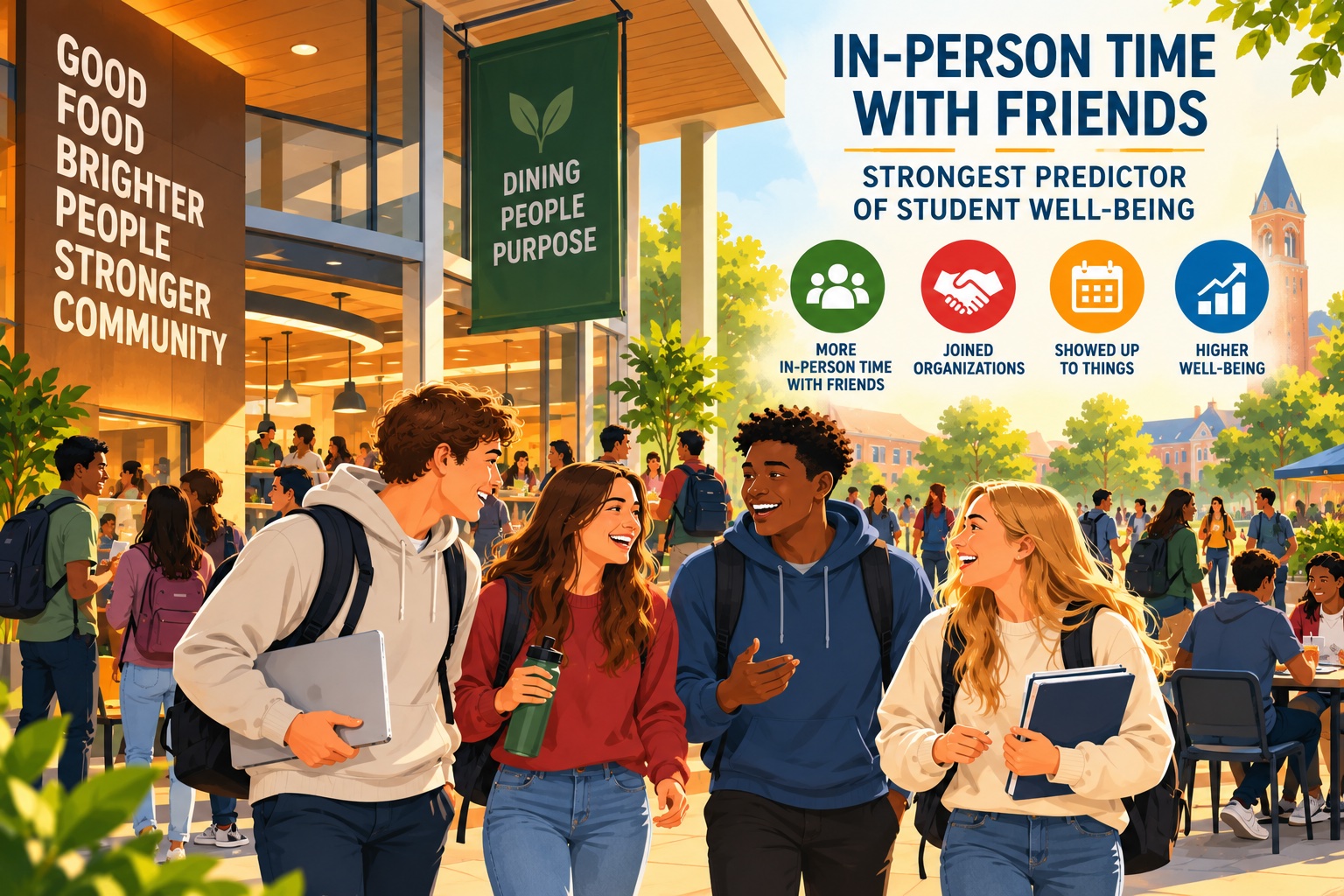
The strongest predictor of flourishing was time spent with other people in person.
Not grades. Not exercise. Not the counseling center. Students who spent time with friends face to face, joined organizations, and showed up to things reported the highest well-being. On the other side of the ledger, sleep problems, problematic substance use, and passive screen time predicted lower well-being, and difficulty in relationships was especially damaging.
The authors added a trend line that explains why the finding matters more now than it would have a generation ago. The share of American high school seniors who saw their friends face to face almost every day fell from 44 percent in 2010 to 32 percent in 2022. The students arriving on your campus have had less practice at the one thing that most predicts whether they will thrive there.
I am not a researcher, and a study like this shows association, not cause. I am pointing at the strongest line in the largest study and asking a practical question: where on your campus is it supposed to happen? And if the answer is the dining hall, why is the dining hall diminished at the exact hours students have for each other: between meals, late at night, and on weekends?
Everyone’s Goal, Nobody’s Room
Over the past thirty-six years of interviewing newly minted freshmen, I have asked what they were looking forward to about college back when they were high school seniors. The answer comes back in two words, almost universally: freedom and social.
The campus funds the first word with a curriculum and leaves the second to chance. Walk through a strategic plan and count the budget lines aimed at the things the study says predict lower well-being: counseling for the symptoms, wellness apps for the sleep, programs for the substance use. All of them necessary. Now count the lines aimed at the thing that predicts higher well-being. In-person time with other students is treated as something they will arrange for themselves, in their free hours, if they happen to be the kind of person who does.
Many of them are not. Half of them arrived having seen friends daily less often than their older siblings did. The ones the British loneliness researchers describe as apprehensive about reaching out will not join the club or go to the event. A program will not reach them. A room might, if the room is open when they are free.
The Room
There is exactly one building on a residential campus whose entire purpose is to put every student in a room with other students, two and three times a day, for four years, and ask nothing of them except that they be hungry. It is the residential dining commons. The bookstore sees a student a few times a semester. Parking sees the car. Housing sees the student asleep. The dining commons is the only place the whole community is awake and face to face at the same time.
Friendship is produced by repetition without obligation: the same faces, at the same tables, at the same hours, until the accidental third dinner with the same crew quietly becomes a friend group. That is the mechanism behind the study’s strongest line. A dining program designed around it manufactures in-person time on a schedule, two and three times a day, and evolves a dining transaction into a social transaction, with food playing a supporting role.
I have a name for that kind of program. I call it Intelligent Dining: a residential dining program run on what the evidence says students need, not on what the production schedule finds convenient. The study just handed every campus the evidence. Intelligent Dining is what you do with it.
And here is the part the study cannot see but every dining director can. Whether that room produces in-person time depends entirely on how it is run, and above all on when. Students are not free at 11:30 on a Tuesday morning. They are free at 2:30 in the afternoon, at 10 at night, and all weekend. Those are precisely the hours most dining programs diminish.
Cafeteria or Intelligent Dining
Many dining halls have evolved physically into beautiful commons. What I mean by cafeteria is the operating system still executed inside them. Between meal periods, the doors lock or the menu shrinks to a sandwich case. Late at night, when hunger and friendship both peak, the room is dark. On weekends, when students have more unscheduled time than at any point in the week, hours are shorter and offerings thinner than on a Tuesday. Stations run out thirty to sixty minutes before the posted close. The program is diminished at exactly the three moments the study says matter most. Add the newer layer: lockers, mobile pickup, robot delivery, grab-and-go, every one a meal eaten alone, usually with a screen, which is the exact combination the study flags. Run that way, the room built for in-person time is engineered to minimize it. That is not a dumb program. It is one that ignores what is known about the students it serves.
Intelligent Dining runs the other way, and every element of it is a decision made in light of the evidence. Hours built around the Student Clock rather than the labor schedule, which means the room is at full strength between meals, late at night, and on weekends, not at its weakest. Predictable Abundance, so the room is worth returning to at 8:45 on a Sunday. Table configurations that invite joining, so a student eating alone is still inside the hum of the crowd, which is a form of in-person time too. The staff who learn names by the second week of September. None of it requires a capital campaign. The room already exists, and the students already walk in with a paid plan.
Voluntary participation is the purest measure of value. If your residential commons holds roughly 70 percent meal plan participation without equivalencies, swipes, or exchanges in retail propping up the count, you are running Intelligent Dining, and you are delivering the study’s strongest predictor to most of your campus every day without a single program.
Our mini documentary, SOCIAL ARCHITECTURE™: The Missing Ingredient, directed by Emmy Award-winning filmmaker Nick Nanton, was filmed on four campuses across two countries. The voices are first-year students describing what it feels like when a campus engineers belonging instead of leaving it to chance. Watch the mini documentary. They are describing the findings from the inside.
The Question for the Cabinet
Eighty thousand students just told the researchers what helps them flourish, and it is the thing your campus already has a building for. So bring one question to the next cabinet meeting: is our dining commons programmed, staffed, and measured as the place where in-person time happens, or as a food service line? Then pull the posted hours and circle every gap between meals, every early close, every weekend cutback. Each circle is an hour the campus took away from the strongest predictor of student well-being. Cafeteria or Intelligent Dining. There is no third answer.
Across nearly 500 campuses over more than three decades, many of our clients have reported that student retention increased by 1 to 3 points after their programs were rebuilt through SOCIAL ARCHITECTURE™. The study explains why. Students who flourish stay. Students who flourish do it with other people, in person. And the only room on campus designed to deliver that at scale is the one most institutions have never thought of as well-being infrastructure at all.
That is not only solvable, but preventable. The room is yours and the evidence is in. Run it as Intelligent Dining, through the lens of SOCIAL ARCHITECTURE™ and Abundance Thinking, and then walk through it at 10 p.m. on a Saturday, the hour most programs have gone dark, and watch the strongest predictor of student well-being happening at every table.
Sources
- “What matters most for undergraduates’ psychological well-being? A structural equation model analysis of modifiable behaviors in the ACHA-NCHA,” Journal of American College Health, 2026, DOI 10.1080/07448481.2026.2721429. Sample: 79,246 students in the United States and Canada, drawn from the American College Health Association’s National College Health Assessment.
- “Spending in-person time with friends is the biggest predictor of whether college students flourish,” The Conversation, October 2026, republished by Phys.org and others. https://theconversation.com/spending-in-person-time-with-friends-is-the-biggest-predictor-of-whether-college-students-flourish-293908
- “Eating Together, Eating Alone,” International Journal of Environmental Research and Public Health, vol. 23, no. 6, article 739, June 1, 2026 (the UK student survey referenced for apprehension about reaching out). https://www.mdpi.com/1660-4601/23/6/739
- David Porter, The Porter Principles, 2nd ed., 2014.
- SOCIAL ARCHITECTURE™: The Missing Ingredient, mini documentary directed by Nick Nanton. https://40059452.hs-sites.com/en/social-architecture%EF%B8%8F-the-missing-ingredient-official-mini-documentary